

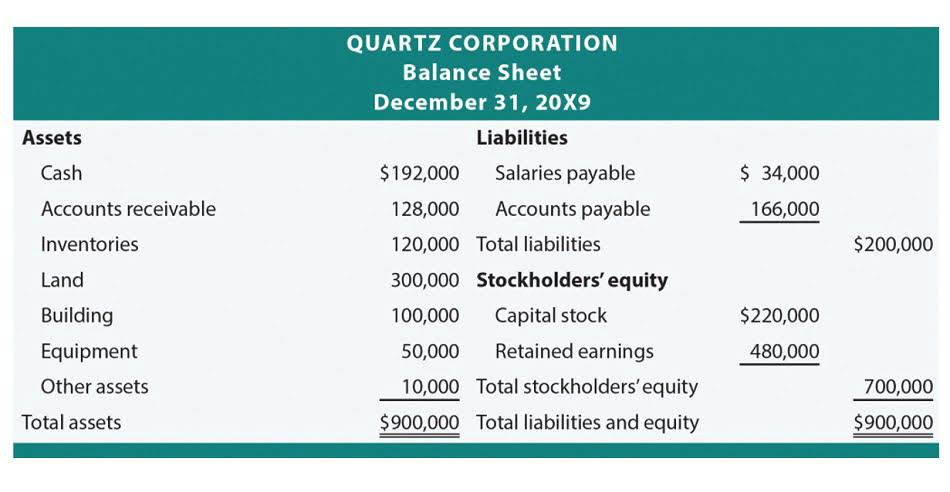
Current accounts or savings that can be easily accessed and turned into cash will be on the top, followed by more liquid investments like stocks or bonds. On the balance sheet, How to Run Payroll for Restaurants assets and liabilities of a company are presented. A company that is financially healthy should have enough current assets such as cash or account receivables to settle their current liabilities. The balance sheet is an important report of the financial statements. Within the balance sheet, we can find information on the assets, liabilities and shareholders’ equity of a company. The order of items in the balance sheet ensures clarity, transparency, and consistency in financial reporting.
3 General presentation requirements

The Financial Accounting Standards Board (FASB) and the International Financial Reporting Standards (IFRS) require companies to present assets in a way that reflects their accessibility. Publicly traded companies must follow these guidelines to ensure comparability across industries and markets, helping investors make informed decisions. Learn how asset accounts are structured by liquidity, why this order matters, and how it helps assess financial health and decision-making.
Non-Current Liabilities
Companies will generally disclose what equivalents it includes in the footnotes to the balance sheet. In general, balance sheet liquidity order having a high amount of cash or cash equivalents indicates a high level of liquidity. This is because these kinds of assets can be quickly utilized to cover any unforeseen expenses or financial obligations.
What Is the Balance Sheet Formula?
- This is helpful for varied stakeholders in comparing, analyzing, and decision making as they can easily compare two or more balance sheets of either the same company or any other company.
- As noted above, you can find information about assets, liabilities, and shareholder equity on a company’s balance sheet.
- This structure helps investors and creditors see what assets the company is investing in, being sold, and remain unchanged.
- Inventory and accounts receivable take time to monetize, so they are less liquid.
- For the past 52 years, Harold Averkamp (CPA, MBA) has worked as an accounting supervisor, manager, consultant, university instructor, and innovator in teaching accounting online.
Assets are typically presented from the most liquid to the least liquid to provide a clear picture of cash availability. The concept of liquidity refers to the ease with which an asset can be converted into cash without a significant loss in its value. Financial liquidity refers to the ease and speed with which an asset can be converted into cash without a significant loss in value. Cash itself is considered the most liquid asset because it is immediately available for use. Other assets are ranked based on how quickly they can be transformed into cash. The order of liquidity is the order in which assets are listed on a balance sheet, starting with the most liquid assets and ending with the least liquid assets.
- The order of items in the balance sheet ensures clarity, transparency, and consistency in financial reporting.
- Cash is the most liquid asset, as it can be easily converted into cash without any significant loss of value.
- Common errors include wrong classification of assets and liabilities.
- At Financopedia, we’re committed to assisting small businesses and individuals with their finances and taxes.
- This asset section is broken into current assets and non-current assets, and each of these categories is broken into more specific accounts.
- This order of liquidity provides a clearer picture of the company’s financial situation, showing how well it can meet its short-term obligations and how effectively it can convert its assets into cash.
Order of Liquidity in Accounting: A Comprehensive Guide
When a company is first formed, shareholders will typically put in cash. Cash (an asset) rises by $10M, and Share Capital (an equity account) rises by $10M, balancing out the balance sheet. This line item includes all of the company’s intangible fixed assets, which may or may https://www.kolnoam.com/stock-earnings-per-share-calculator-to-calculate/ not be identifiable.

Assets that can convert into cash within 12 months are considered current assets, while others are treated as non-current assets. A liquidity ratio is a type of financial ratio used to determine a company’s ability to pay its short-term debt obligations. The metric helps determine if a company can use its current, or liquid, assets to cover its current liabilities.
